A T-bone (side-impact) crash in California usually turns on who had the right-of-way: a driver facing a steady red light must stop (Vehicle Code section 21453), a driver at a stop sign must yield to close approaching traffic (Vehicle Code section 21802), and a driver turning left must yield to oncoming vehicles close enough to be a hazard (Vehicle Code section 21801). Fault can be shared, and you generally have two years to sue (Code of Civil Procedure section 335.1). Our office is open 24/7 and calls are answered at (619) 525-7007.
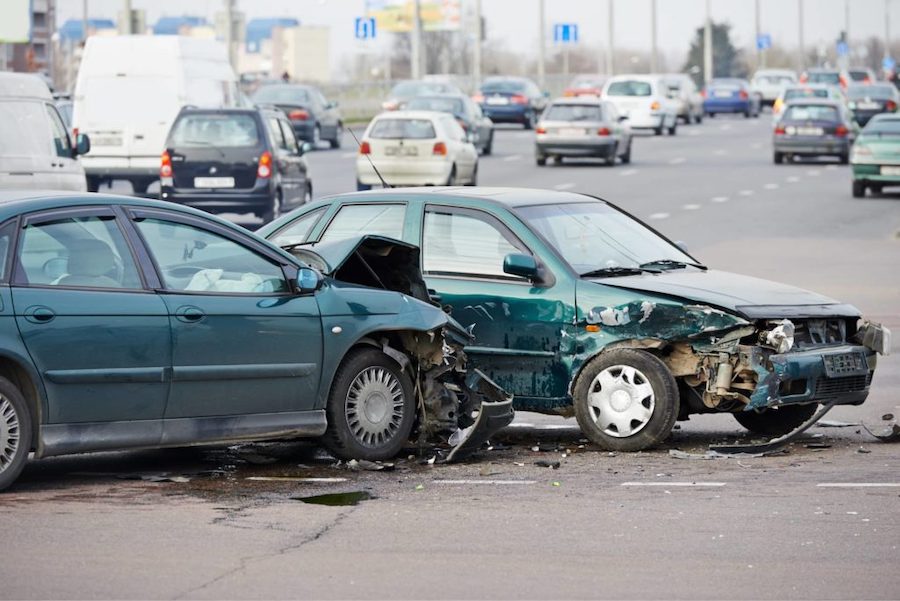
A T-bone collision happens when the front of one vehicle strikes the side of another. The side of a car has less structure between the occupant and the striking vehicle than the front or rear, so these crashes can cause brain injuries, spinal injuries, broken bones, and deaths. They often follow a red-light or stop-sign violation, a rushed left turn, speeding, or a distracted driver.
California law explained: right-of-way and fault in side-impact crashes
- Fault standard: everyone is responsible for injuries caused by a lack of ordinary care in operating a vehicle (Civil Code section 1714).
- Comparative fault: a jury assigns each party a percentage, and an injured person’s recovery is reduced by their own share, not barred. The jury instruction is CACI 405 (Comparative Fault of Plaintiff).
- Several liability for non-economic damages: when several defendants share fault, each pays non-economic damages only in proportion to their own percentage (Civil Code section 1431.2).
- Uninsured drivers: an injured driver who had no required insurance, or who was convicted of DUI for the crash, generally cannot recover non-economic damages (Civil Code section 3333.4).
- Deadline: generally two years to file suit (Code of Civil Procedure section 335.1); a claim involving a government vehicle or a signal a city maintains generally requires a written claim within six months (Government Code section 911.2).
Legislative history of the right-of-way rules
The uncontrolled-intersection rule in Vehicle Code section 21800 was last amended by Stats. 2009, Ch. 200 (SB 734). The left-turn rule in Vehicle Code section 21801 was last amended by Stats. 1993, Ch. 272. The stop-sign and yield-sign rules in Vehicle Code section 21802 and Vehicle Code section 21803 were last amended by Stats. 1988, Ch. 623. The red-signal rule in Vehicle Code section 21453 was last amended by Stats. 2022, Ch. 957 (AB 2147). Proportional liability for non-economic damages came from Proposition 51 (June 3, 1986), and pure comparative fault from the California Supreme Court’s 1975 decision in Li v. Yellow Cab Co. (1975) 13 Cal.3d 804.
Right-of-Way Rules Behind Most T-Bone Crashes
Side-impact crashes usually happen at intersections, where one driver failed to yield. These Vehicle Code rules are often the starting point for deciding fault:
- Uncontrolled intersections: a driver must yield to any vehicle that has already entered the intersection from a different highway; when two vehicles enter at the same time, the driver on the left yields to the vehicle on the immediate right (Vehicle Code section 21800). The same left-yields-to-right rule applies at all-way stops and at intersections where the signals are dark.
- Left turns: a driver turning left must yield to oncoming traffic close enough to be a hazard (Vehicle Code section 21801).
- Stop signs: a driver must stop and then yield to vehicles approaching so closely as to be an immediate hazard; after yielding, that driver may proceed and other drivers must yield (Vehicle Code section 21802).
- Yield signs: a driver must yield to vehicles already in the intersection or close enough to be an immediate hazard (Vehicle Code section 21803).
- Red lights: a driver facing a steady red signal must stop and stay stopped until it turns green, unless a turn on red is allowed (Vehicle Code section 21453).
- Speed: no one may drive faster than is reasonable for weather, visibility, and traffic, or at a speed that endangers people or property (Vehicle Code section 22350).
- Turns and lane changes: no driver may turn or move left or right until it can be done safely and after an appropriate signal (Vehicle Code section 22107).
Who is at Fault in a T-Bone Car Accident?
Fault in a T-bone crash is not automatic. The driver whose front end struck the other car is not always the one at fault. A driver who ran a red light and was hit broadside by a driver with a green light may bear most of the fault. In other cases a third party is involved: a driver who waved someone through, a company whose truck blocked the view, or a public agency responsible for a signal that was not working.
Even a driver with the right-of-way can share some fault if they were speeding (Vehicle Code section 22350) or distracted and could have avoided the crash. Police reports, witness statements, video, vehicle damage patterns, and event data recorder readings are used to sort out what happened.
What Does Comparative Fault Mean?
For example, if a jury finds one driver 80 percent at fault and the injured driver 20 percent at fault, the injured driver recovers 80 percent of their damages. When more than one other party is at fault, economic damages can be recovered from any of them, but each defendant’s share of non-economic damages is limited to that defendant’s percentage of fault (Civil Code section 1431.2). Read how comparative fault is decided in California for the shared California law.
After a T-bone crash: steps and records
After a T-bone crash, photograph the signal or stop sign facing each driver and ask nearby businesses about intersection video. The general rules are on the driver duties California law sets after any crash.
Evidence that matters
- Photos of both vehicles, including where the side impact landed.
- The signal phase or sign each driver faced, and the location of any traffic cameras.
- Names and phone numbers of witnesses.
- Nearby business or home security video, requested quickly before it is overwritten.
- The police report number.
- Medical records from the first visit forward.
Common T-bone crash injuries
Side impacts leave little crush space between the door and the occupant, so head, pelvis, and rib injuries on the struck side are common. our brain injury page has the full background.
Damages in T-bone crash claims
In a T-bone claim, the damages actually recovered often turn on how fault is split between two drivers who each claim the right-of-way. Read our explainer on economic and non-economic damages for the shared California law.
Deadlines for T-bone crash claims
If a broken signal or a city intersection design contributed, a government claim is due within six months. The general rules are on the two-year rule and its exceptions.
Related injury pages
See our Injury Trial Lawyers home page, San Diego car accident page, catastrophic injury page, wrongful death page.
T-bone accident questions and answers
What if a vehicle defect made my injuries worse?
If a defect, such as a failed seat belt, airbag, or weak side structure, caused or worsened injuries, a product liability claim against the manufacturer may be possible in addition to a claim against the driver.
Can a passenger file a claim after a T-bone crash?
Yes. Passengers can generally make claims against whichever driver or drivers were at fault, including the driver of the car they were in.
Do I have to report a car accident to the DMV?
Yes, if anyone was injured or killed, or property damage exceeded $1,000. A report must be filed with the DMV within 10 days on form SR-1 (Vehicle Code section 16000), separate from any police report.
How long do I have to file a personal injury claim in California?
Generally two years from the date of injury (Code of Civil Procedure section 335.1). If a government agency may be responsible, a written claim usually must be filed within six months (Government Code section 911.2).
Who has the right-of-way at an uncontrolled intersection?
A driver must yield to a vehicle that has already entered the intersection from a different road. When two vehicles enter at the same time from different roads, the driver on the left yields to the driver on the right (Vehicle Code section 21800).
What if the traffic lights were out?
Treat the intersection as an all-way stop: stop, proceed with caution when safe, and when two vehicles enter at the same time, the driver on the left yields to the driver on the right (Vehicle Code section 21800).
Can I recover if I was partly at fault for a T-bone crash?
Yes. California’s pure comparative fault rule reduces your recovery by your share of fault rather than barring it.
How do attorney fees work?
No attorney fee unless we recover. If there is no recovery, you owe no attorney fees and no case costs, as stated in your fee agreement.
How do I reach Injury Trial Lawyers?
Injury Trial Lawyers is open 24/7, and calls are answered at (619) 525-7007.
This page is general information about California law, not legal advice.
Sources
- California Code of Civil Procedure section 335.1
- California Civil Code section 1431.2
- California Civil Code section 1714
- California Civil Code section 3333.4
- California Government Code section 911.2
- California Vehicle Code section 21453
- California Vehicle Code section 21800
- California Vehicle Code section 21801
- California Vehicle Code section 21802
- California Vehicle Code section 21803
- California Vehicle Code section 22107
- California Vehicle Code section 22350
- Judicial Council of California, Civil Jury Instructions (CACI), 2026 edition