
What should be done, if one fells at a restaurant and suffers injury?

Short answer: After a fall at a restaurant in National City or elsewhere in San Diego County, the claim usually turns on evidence that disappears quickly: security video, the incident report, cleaning logs and witness names. California law requires you to show the restaurant knew, or should have known, about the hazard in time to fix it or warn you (CACI 1003, 1011). Read more on our San Diego premises liability page or about our National City personal injury work.
1. Get medical care first
Some fall injuries, such as head injuries and fractures, are not obvious right away. Getting checked promptly protects your health and creates a record linking the injury to the fall.
2. Ask for an incident report
Tell the manager what happened before you leave and ask them to write an incident report. Ask for a copy. If they will not give you one, write down the manager’s name and the time you reported it. Do not guess about what caused the fall or sign anything admitting fault.
3. Video: act within days
Many restaurants use camera systems that record over footage automatically, sometimes within days. A lawyer can send a preservation letter asking the restaurant and its insurer to save video, cleaning and inspection logs, and the incident report. Once a party is on notice that litigation is reasonably likely, destroying relevant evidence can lead to court sanctions or a jury instruction that the missing evidence would have been unfavorable to them (CACI 204).
4. Photograph the hazard and any warning sign
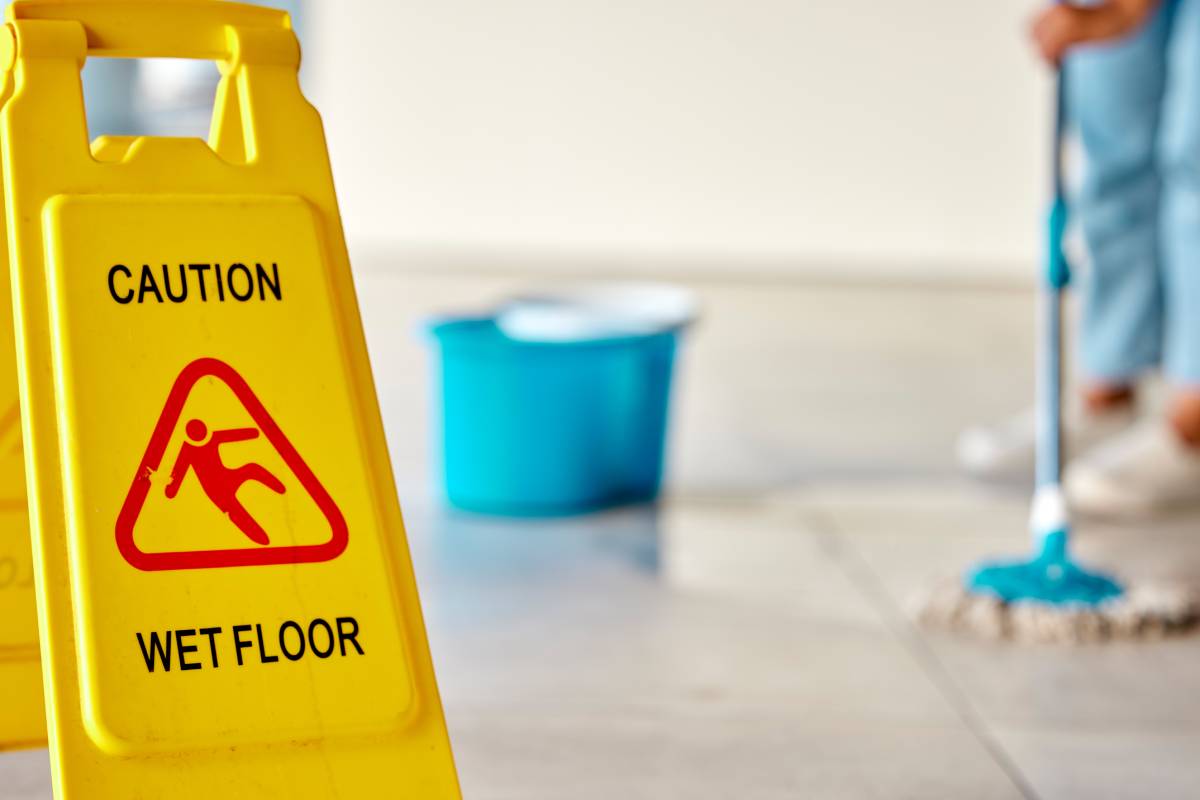
Take photos of the floor, the spill or debris, the lighting, and your shoes. Note whether a wet-floor sign was present and where it was placed. A sign can matter: an owner must use reasonable care to repair, protect against or give adequate warning of an unsafe condition (CACI 1003), so a sign placed far from the spill, or no sign after mopping, can be important evidence.
5. Notice: did they know or should they have known?
You generally must show the restaurant had actual notice of the hazard, or constructive notice, meaning it existed long enough that a reasonable inspection would have found it (CACI 1011; Ortega v. Kmart Corp. (2001) 26 Cal.4th 1200). If an employee created the hazard, for example by spilling a drink or mopping without warning, notice may not be required. Evidence of how often staff inspected the floor is often the key issue.
6. Get witness names now
Other diners and staff may remember the spill, how long it was there, or a prior complaint. Get names and phone numbers before you leave; they are hard to find later.
7. Keep track of costs and deadlines
Keep medical bills, receipts and records of missed work. A lawsuit against a private restaurant generally must be filed within two years (Code Civ. Proc. § 335.1). If the fall happened at a restaurant on public property, such as a city-owned pier or airport, a written government claim may be due within six months (Gov. Code § 911.2). If you were partly at fault, your recovery is reduced by your share of fault (Li v. Yellow Cab Co. (1975) 13 Cal.3d 804).
Sources: Code of Civil Procedure section 335.1; Government Code section 911.2; Civil Code section 1714 (duty of ordinary care); CACI 1003 and CACI 1011 (property-owner liability jury instructions).
Injury Trial Lawyers is open 24/7, and calls are answered at (619) 525-7007. Request a free consultation. No attorney fee unless we recover. If there is no recovery, you owe no attorney fees and no case costs, as stated in your fee agreement.